
The gaming world is evolving faster than ever, and if you’re searching for insights into gaming industry trends 2026, you’re likely trying to understand what’s next—whether that’s new hardware, shifting player expectations, cross-platform performance, or the growing role of Linux and alternative systems in modern gaming setups.
This article breaks down the most important developments shaping the year ahead, from console vs. PC dynamics to optimization strategies and engine compatibility that directly impact how (and where) you play. Instead of surface-level predictions, we analyze current market data, developer movements, hardware advancements, and real performance benchmarks to connect the dots between today’s innovations and tomorrow’s standards.
If you want a clear, practical look at where gaming is heading—and how those shifts affect your setup, performance, and buying decisions—this guide delivers focused, research-backed insights designed to keep you ahead of the curve.
Beyond the Hype: What Gaming Actually Looks Like in 2026
The future of gaming isn’t a sci‑fi trailer—it’s measurable. Analysts project the global games market to surpass $250 BILLION by 2026 (Newzoo), driven largely by cloud access and cross‑platform ecosystems. That means fewer plastic boxes under TVs and more hybrid libraries that run anywhere (yes, even on Linux builds with Proton improvements).
Some argue VR will dominate. Yet VR adoption remains under 3% of Steam users (Valve Hardware Survey, 2025), suggesting steady growth—not takeover. The real shift? Services, portability, and smarter optimization. gaming industry trends 2026 point to PERFORMANCE-FIRST design, faster SSD standards, and AI-assisted development pipelines becoming STANDARD.
The New Console War: Hybrid PCs and Handheld Dominance
By 2026, the old “console vs. PC” argument feels a bit like debating Blu-ray vs. streaming (nostalgic, but missing the point). The line is blurring fast.
The Blurring Line
Next-gen console refreshes are adopting PC-style features: adjustable graphics settings, performance modes, even more open storefront policies. In practical terms, that means you’ll need to think less about platform loyalty and more about ecosystem flexibility (how easily your games and saves move between devices).
Some players argue consoles should stay “plug-and-play.” And that’s fair—simplicity is their charm. But optional advanced settings don’t remove simplicity; they add choice. If you want 60 FPS over ray tracing, you’ll finally get to decide.
Pro tip: Always prioritize frame rate over ultra settings on shared living room displays. Smoother gameplay typically improves reaction time and overall experience (NVIDIA developer guidance consistently emphasizes performance stability over peak visuals).
The Handheld Revolution
The Steam Deck proved high-fidelity portable gaming is viable. Now, major manufacturers are entering the space. A handheld PC is essentially a compact gaming computer running a desktop OS with controller-first inputs.
If you’re building a 2026-ready setup:
- Choose a powerful main rig (desktop or console).
- Pair it with a handheld capable of native or remote play.
- Enable cloud saves across platforms.
That trio creates flexibility without redundancy.
Linux Gaming’s Ascent
Compatibility layers like Proton translate Windows game calls into Linux-friendly instructions. Performance has steadily improved, with Valve reporting thousands of verified titles playable on SteamOS.
Skeptics say Linux will always lag behind Windows. Historically, yes. But handheld demand is accelerating optimization—one of the clearest gaming industry trends 2026 is platform-agnostic development.
The result? Your “setup” is no longer one box. It’s a connected system that follows you everywhere.
Cloud Gaming Matures: The End of Downloads?

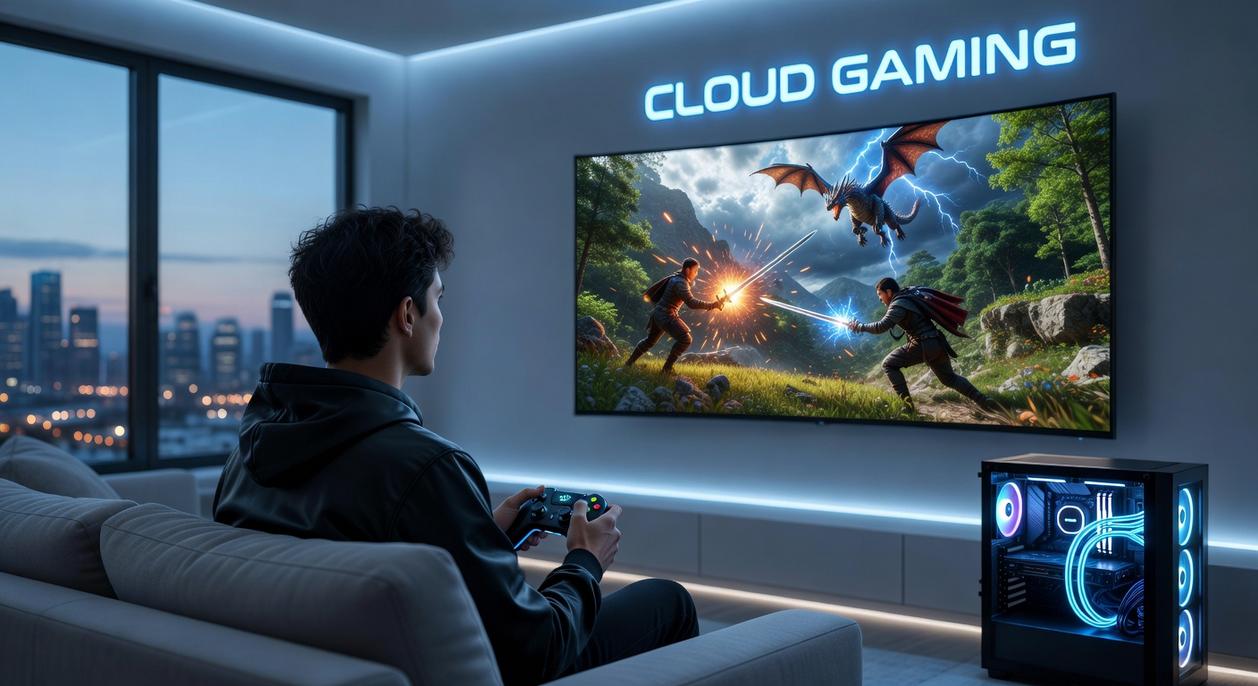
Cloud gaming in 2026 isn’t a flashy experiment anymore. It’s a button. You open your console dashboard or PC launcher and see “Play Now” beside titles you already own. No 80GB download. No day-one patch marathon. Just click and go (which, let’s be honest, feels slightly magical the first time).
Skeptics argue we’ve heard this before. Latency, they say, will always ruin competitive games. And historically, they had a point. Early cloud platforms struggled with input lag—the delay between pressing a button and seeing the action on-screen. But advances in AV1 encoding (a more efficient video compression standard) and edge computing—processing data closer to the user—have slashed that delay. NVIDIA and Microsoft both report measurable latency reductions in recent infrastructure updates (NVIDIA Developer Blog, 2024; Microsoft Azure Edge Zones documentation). Fast enough now for multiplayer shooters? Increasingly, yes.
Subscription synergy is accelerating adoption. Services like Game Pass Ultimate already bundle cloud access, and publishers are expected to follow suit. Instant libraries reduce friction dramatically. This shift pairs naturally with broader gaming industry trends 2026, where accessibility often trumps raw hardware power.
Critics insist local hardware will always win. They’re not wrong—native installs still offer peak fidelity and mod support. But cloud gaming extends aging PCs’ relevance and lowers entry costs for new players. It also complements ecosystems shaped by how cross platform play is changing online multiplayer.
The result? Downloads won’t disappear—but they won’t dominate either.
AI-Powered Worlds and Smarter Optimization
The conversation around AI in games usually stops at prettier graphics. That’s shortsighted. The real shift isn’t cosmetic—it’s systemic.
Generative NPCs
By 2026, generative NPCs—non-playable characters powered by large language models and memory systems—will hold unscripted conversations and recall prior player choices. Think less “press X to continue dialogue,” more Westworld-style emergent storytelling (minus the robot uprising, hopefully). Unlike branching dialogue trees, these systems dynamically assemble responses based on stored interaction data, creating persistent social consequences.
Skeptics argue this risks immersion-breaking glitches or repetitive AI phrasing. Fair point. Early AI chat systems have shown those cracks. But with on-device inference acceleration and curated training layers, studios can constrain outputs while preserving spontaneity.
Procedural Content 2.0
Procedural generation isn’t new. What’s new is AI-guided asset coherence. Instead of random terrain seeds, developers use machine learning models trained on art direction datasets to maintain visual and narrative consistency.
Pro tip: Expect smaller studios to compete visually with AAA teams as asset generation pipelines compress production timelines.
The Next Generation of Upscaling
AI upscaling like DLSS and FSR already reconstructs frames using lower-resolution renders. By late-cycle adoption, native 4K rendering may become inefficient overhead. The frontier shifts toward:
- AI-driven frame generation
- Predictive input latency reduction
- Per-display refresh rate adaptation
Critics say “native is always better.” But blind tests consistently show modern reconstruction methods rivaling native output while improving performance (NVIDIA, 2024).
Automated Optimization
Why should players manually tweak 20 graphics sliders in 2026? AI-configured launchers will benchmark hardware in real time, auto-balancing CPU, GPU, and memory loads. This goes beyond presets—it’s hardware-specific orchestration.
In discussions of gaming industry trends 2026, most analysts fixate on visuals. The deeper competitive edge lies in invisible intelligence—the optimization layers players never see, but always feel.
Your Next Move: Thriving in the New Gaming Era
Let’s be honest: the future of gaming isn’t a single console sitting under your TV. It’s a hybrid, AI-enhanced, accessible ecosystem—and I think that’s a good thing. We’re watching gaming industry trends 2026 point toward flexibility over loyalty to any one plastic box (yes, even that one you camped overnight for).
The real challenge isn’t power anymore; it’s pace. Platforms now matter more than hardware cycles. A gaming ecosystem—your combined setup of devices, subscriptions, and services—determines how and where you play. Handheld PCs let you take your full library on the go. Meanwhile, mature cloud gaming services reduce the need for constant upgrades (assuming your internet behaves).
Some argue local hardware will always win. I partly agree—latency still matters. But ignoring AI-driven performance boosts and upscaling is shortsighted.
So here’s my take: build flexibly. Start small if needed—a cloud sub, a GPU refresh, or a handheld. Then expand intentionally.
Stay Ahead of the Curve in 2026
You came here to understand where the industry is heading and how the latest gaming industry trends 2026 will shape your setup, your performance, and your long-term gaming experience. Now you have a clearer picture of the technologies, platforms, and optimization strategies driving the next wave of innovation.
The real challenge isn’t just knowing what’s coming—it’s making sure your system, engine, and strategy are ready for it. Falling behind on hardware upgrades, ignoring Linux compatibility, or overlooking performance tuning can cost you smoother gameplay, competitive edge, and long-term value.
Take action now. Review your current setup, optimize your system for peak performance, and explore tools and engines that align with where the market is heading. Thousands of gamers rely on our insights to fine-tune their rigs and stay competitive—don’t get left behind.
Level up your gaming strategy today. Dive deeper, upgrade smarter, and make your next move count.

 Kenneth Lesheradero is the kind of writer who genuinely cannot publish something without checking it twice. Maybe three times. They came to game optimization tips through years of hands-on work rather than theory, which means the things they writes about — Game Optimization Tips, Hot Topics in Gaming, Expert Breakdowns, among other areas — are things they has actually tested, questioned, and revised opinions on more than once.
That shows in the work. Kenneth's pieces tend to go a level deeper than most. Not in a way that becomes unreadable, but in a way that makes you realize you'd been missing something important. They has a habit of finding the detail that everybody else glosses over and making it the center of the story — which sounds simple, but takes a rare combination of curiosity and patience to pull off consistently. The writing never feels rushed. It feels like someone who sat with the subject long enough to actually understand it.
Outside of specific topics, what Kenneth cares about most is whether the reader walks away with something useful. Not impressed. Not entertained. Useful. That's a harder bar to clear than it sounds, and they clears it more often than not — which is why readers tend to remember Kenneth's articles long after they've forgotten the headline.
Kenneth Lesheradero is the kind of writer who genuinely cannot publish something without checking it twice. Maybe three times. They came to game optimization tips through years of hands-on work rather than theory, which means the things they writes about — Game Optimization Tips, Hot Topics in Gaming, Expert Breakdowns, among other areas — are things they has actually tested, questioned, and revised opinions on more than once.
That shows in the work. Kenneth's pieces tend to go a level deeper than most. Not in a way that becomes unreadable, but in a way that makes you realize you'd been missing something important. They has a habit of finding the detail that everybody else glosses over and making it the center of the story — which sounds simple, but takes a rare combination of curiosity and patience to pull off consistently. The writing never feels rushed. It feels like someone who sat with the subject long enough to actually understand it.
Outside of specific topics, what Kenneth cares about most is whether the reader walks away with something useful. Not impressed. Not entertained. Useful. That's a harder bar to clear than it sounds, and they clears it more often than not — which is why readers tend to remember Kenneth's articles long after they've forgotten the headline.