

Online games can feel like magic—until lag, desync, or cheating shatter the illusion. If you’ve ever wondered what truly powers smooth online play, this guide breaks it down to the multiplayer netcode basics every developer must understand. We focus on engine-agnostic principles that apply whether you’re building in Unity, Unreal, Godot, or a custom framework. By tackling latency, synchronization, and anti-cheat from first principles, we cut through the noise and explain what actually keeps players connected. Drawing on industry-standard networking models and proven engineering practices, this article gives you a clear, practical roadmap to building stable, responsive multiplayer experiences.
The Core Decision: Client-Server vs. Peer-to-Peer (P2P)
To truly understand the intricacies of multiplayer netcode and server architecture, it helps to explore foundational concepts discussed in our article on ‘Video Games Pblinuxtech,’ where we delve into the technical underpinnings that support engaging online gameplay.
Before you optimize a single line of code, you need to choose your networking architecture. Get this right, and everything from cheat prevention to player experience becomes easier.
The Authoritative Server Model
In this model, a central server acts as the source of truth—meaning it has the final say on player positions, damage, and game outcomes. If two players disagree, the server wins.
The benefits are clear: stronger cheat prevention, consistent game state control, and smoother large-scale matches. That’s why competitive FPS titles, MMOs, and RTS games rely on it. However, critics argue it’s expensive and creates a single point of failure. They’re not wrong—server outages can bring everything down. Still, if competitive integrity matters, the control is worth the cost (think esports-level fairness).
The P2P Model
Peer-to-peer connects players directly, without a central authority. This lowers infrastructure costs and can reduce latency between nearby players. Sounds great, right?
Yet it’s more vulnerable to cheating, and host migration—when the host leaves and control shifts—can disrupt sessions. Synchronization also becomes trickier as player counts grow.
Making the Right Choice
Ask yourself: How many players? How competitive? How persistent is the world? For small co-op or 1v1 fighting games, P2P shines. For ranked shooters, authoritative servers dominate.
Understanding multiplayer netcode basics helps you align architecture with your goals—and ultimately deliver smoother, fairer gameplay. (Pro tip: always prototype both before scaling.)
Game State Synchronization: The Single Source of Truth
First, let’s define game state. It’s the complete snapshot of all relevant data in a game world at a single moment—player positions, health, ammo counts, cooldown timers, objective status, even physics data. Think of it as a freeze-frame of the entire match. If you could pause an online shooter mid-match like in The Matrix, that frozen scene is the game state.
However, sending that entire snapshot every frame would be a networking nightmare. Modern games run at 30–60 frames per second or more. Transmitting full state data that often would overwhelm bandwidth and introduce massive lag (and nobody enjoys teleporting enemies). This is where multiplayer netcode basics come into play.
Instead of sending everything, servers use delta compression—only transmitting what changed since the last update. If a player hasn’t moved, there’s no need to resend their position. Periodically, the server sends full snapshots to correct any small mismatches, preventing long-term drift between players’ views.
Finally, not all data is equal. Critical inputs like shooting or movement are prioritized and sent more frequently than cosmetic updates like emotes or skin animations. As a result, gameplay feels responsive, which directly improves fairness and competitive integrity. (Pro tip: stable wired connections reduce packet loss, making synchronization even smoother.)
Tackling Latency: The Art of Illusion
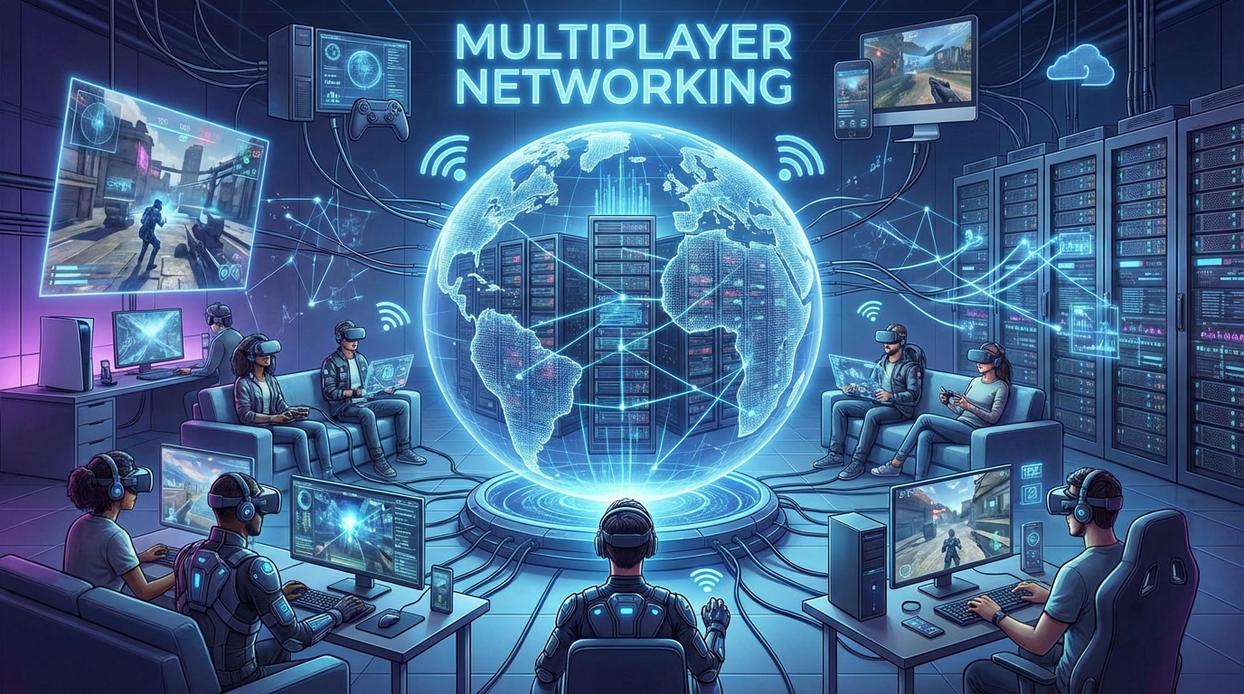
I still remember the first time I noticed latency ruining a match. I ducked behind cover in a shooter—ON MY SCREEN I WAS SAFE—yet the kill cam showed me standing in the open. That frustrating gap? That’s latency.
Latency (often called ping) is the time it takes for data to travel from your device to the game server and back. It’s measured in milliseconds. Even at the speed of light, data crossing continents takes time. That’s physics, not bad coding. Some players argue better servers alone can “fix” lag. Improved infrastructure helps, sure—but distance and routing limits remain (a harsh reality of cables under oceans).
So developers lean on illusion.
Client-Side Prediction
Client-side prediction lets your game simulate your input instantly instead of waiting for the server. Press jump? Your character jumps NOW. The server confirmation comes later. Without this trick, games would feel like steering a boat through molasses. This is one of the core multiplayer netcode basics techniques that keeps controls responsive.
Server Reconciliation
Here’s the catch: the server is the authority. When it sends back the “true” state, your client compares it to its prediction. If there’s a mismatch, it corrects it. That tiny snap you sometimes see? That’s reconciliation at work. It’s subtle—when done right, you barely notice.
Entity Interpolation
Other players are smoothed using interpolation. Instead of snapping enemies between updates, the client animates them between known positions. The result feels fluid, even if packets arrive unevenly (kind of like buffering in a Netflix stream).
Pro tip: wired connections reduce packet loss noticeably (FCC, 2023).
If you’re curious how clever systems create massive worlds, check out how procedural generation shapes open world games.
Choosing Your Protocol: TCP vs. UDP
TCP (Transmission Control Protocol) is the overachiever of networking. It guarantees reliable, ordered delivery, meaning packets arrive complete and in sequence. If something gets lost, it resends it. Sounds great, right? For downloads, absolutely. But in games, that strict ordering can feel like waiting for dial-up in a fiber world. A delayed packet holding up the rest slows everything down.
UDP (User Datagram Protocol) is the opposite. It’s fast, unordered, and unreliable. Fire-and-forget. No apologies, no retries. And that’s why I prefer it for real-time play. In multiplayer netcode basics, speed beats perfection. If a player’s position update vanishes, the next one arrives milliseconds later.
Some argue reliability should always come first. I disagree. For game state, an old, delayed packet is worse than a lost one. Games layer lightweight reliability over UDP for critical events like firing a weapon (no one wants phantom bullets).
Building Your First Connected Experience
You set out to understand what it really takes to build a connected game. Now you know it’s not about flipping a “multiplayer” switch—it’s about mastering your architecture (Client-Server or P2P), state management, latency compensation, and choosing the right protocol for the job. These multiplayer netcode basics are the foundation behind every smooth online experience.
If you’ve ever felt overwhelmed by desyncs, lag spikes, or unpredictable behavior, that frustration usually comes from gaps in these core principles—not your engine.
Now it’s your move. Start small. Build a simple two-player Pong or basic movement demo and watch these concepts come alive. Test, break, fix, repeat—and turn theory into real multiplayer skill.

 is the kind of writer who genuinely cannot publish something without checking it twice. Maybe three times. They came to console vs pc debates through years of hands-on work rather than theory, which means the things they writes about — Console vs PC Debates, Linux-Compatible Game Engines, Hot Topics in Gaming, among other areas — are things they has actually tested, questioned, and revised opinions on more than once.
That shows in the work. Jameson's pieces tend to go a level deeper than most. Not in a way that becomes unreadable, but in a way that makes you realize you'd been missing something important. They has a habit of finding the detail that everybody else glosses over and making it the center of the story — which sounds simple, but takes a rare combination of curiosity and patience to pull off consistently. The writing never feels rushed. It feels like someone who sat with the subject long enough to actually understand it.
Outside of specific topics, what Jameson cares about most is whether the reader walks away with something useful. Not impressed. Not entertained. Useful. That's a harder bar to clear than it sounds, and they clears it more often than not — which is why readers tend to remember Jameson's articles long after they've forgotten the headline.
is the kind of writer who genuinely cannot publish something without checking it twice. Maybe three times. They came to console vs pc debates through years of hands-on work rather than theory, which means the things they writes about — Console vs PC Debates, Linux-Compatible Game Engines, Hot Topics in Gaming, among other areas — are things they has actually tested, questioned, and revised opinions on more than once.
That shows in the work. Jameson's pieces tend to go a level deeper than most. Not in a way that becomes unreadable, but in a way that makes you realize you'd been missing something important. They has a habit of finding the detail that everybody else glosses over and making it the center of the story — which sounds simple, but takes a rare combination of curiosity and patience to pull off consistently. The writing never feels rushed. It feels like someone who sat with the subject long enough to actually understand it.
Outside of specific topics, what Jameson cares about most is whether the reader walks away with something useful. Not impressed. Not entertained. Useful. That's a harder bar to clear than it sounds, and they clears it more often than not — which is why readers tend to remember Jameson's articles long after they've forgotten the headline.